Bitcoin Protocol Development Steadily Progressing Despite Only 40-60 Monthly Active Developers: NYDIG
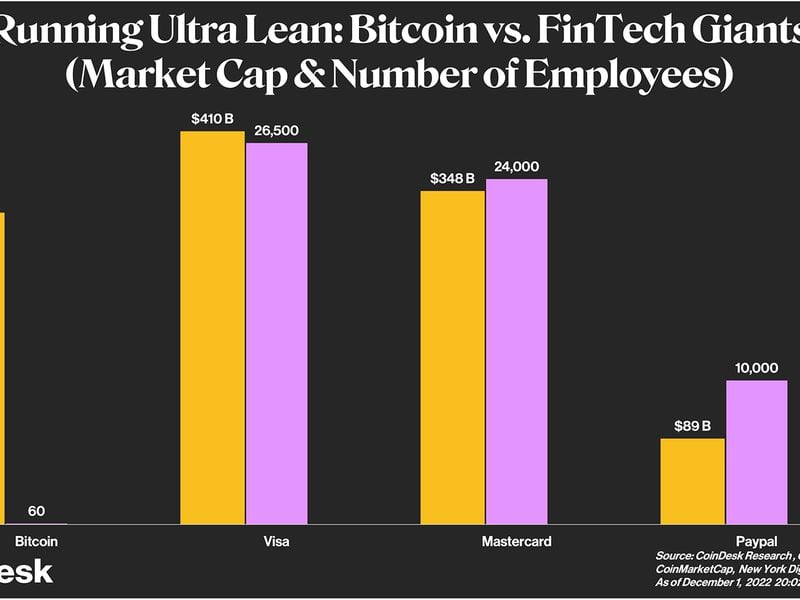
In a world where giants of the conventional financial system including Visa, Mastercard and PayPal employ tens of thousands of employees, Bitcoin continues to be run by a tight ship of just a few dozen active developers.
New York Digital Investment Group (NYDIG), a Bitcoin-focused investment firm, published a report in September chronicling Bitcoinrs 14-year evolution from a software development perspective. The report, titled lDevelopers of Bitcoin,r found that there are only 40 to 60 active developers. The document sheds light on how Bitcoin has steadily grown from an obscure technological breakthrough, to worldwide domination, and examines the software developers who made it all happen.
Whatrs most mind-boggling, perhaps, is how the worldrs most dominant cryptocurrency, currently worth about $320 billion, has been chugging along with no major hiccups for almost 14 years, under the care of a passionate n but small n group scattered across the globe.
lThe purpose of the report was to help people understand Bitcoinrs development cycle: How it evolved from an idea circulated on a mailing group, to a pervasive technology today. And then, who are the people who continue to update the [Bitcoin] protocol,r explained Greg Cipolaro in a recent interview with CoinDesk. Cipolaro is NYDIGrs global head of research and co-author of the report.
Read more: So You Want to Be a Bitcoin Developer?
The Satoshi EraSatoshi Nakamoto, Bitcoinrs pseudonymous founder, published his white paper on Oct. 31, 2008, and subsequently launched the Bitcoin network on Jan. 3, 2009. He was soon joined by five other contributors, notably Hal Finney, a developer and cypherpunk who became the first bitcoin transaction recipient (courtesy of Satoshi), and Laszlo Hanyec, a programmer who famously paid 10,000 BTC (almost $170 million today) for two pizzas.
Read more: What Is Bitcoin Pizza Day?
With Satoshi at the helm, a community formed, but by 2010 that community had outgrown its founder. Realizing this, Satoshi gave Gavin Andresen the keys to the kingdom. Andresen, who was then an active contributor to the project, became Bitcoinrs llead developerr and moved the project to open source collaboration platform, GitHub, paving the way for true decentralization.
lIn a final email to developer Mike Hearn, Satoshi declared, lIrve moved on to other things. Itrs in good hands with Gavin and everyone,rr the report states.
Bitcoin development todayNowadays, Bitcoin developers can be found worldwide. Roughly 84% of its GitHub commits n or suggested software changes n come from 20 different countries.
lOne of the interesting things I thought we uncovered in the report is the geographic location of the developers,r said Cipolaro. lItrs helpful for investors who may be concerned about who's contributing and updating this piece of software. We know who they are and most of them seem to be in North America, Western Europe, those types of geographies.r
Another shift is the recent shelving of the lead developer/maintainer role in favor of a more egalitarian model that elects a group of maintainers instead. A lmaintainerr is essentially a GitHub administrator with permission to approve software changes suggested by other developers.
Earlier this year, Gloria Zhao became the first female Bitcoin maintainer in the community's history.
Bitcoin by the numbersAccording to the report, lcode contributions have reached 200-400 commits monthly,r a steady, measured progression. And although Bitcoinrs core protocol averages 40 to 60 monthly active developers, 1,140 developers have contributed to the project since inception, with 5 to 20 new developers testing the waters every month (as others either scale back or leave).
Monthly Active Developers in Core Protocol and Bitcoin (NYDIG)
The broader ecosystem (developers working on Bitcoin related applications) follows a similar pattern, but, of course, with higher numbers. NYDIG estimates the number of monthly active developers in that wider community to be anywhere from 600 to 1,000, with the total number of contributors being over 13,000 since inception.
When compared to competing networks, Bitcoin always seems to come out smaller, but exponentially more efficient. For example, previous estimates from venture firm, Electric Capitalrs 2021 developer report, show Ethereum has over 4,000 monthly active developers in its broader ecosystem, compared to Bitcoinrs 600 to 1,000, yet Ethereumrs current market capitalization is less than half of Bitcoinrs.
Similarly, traditional payment firms such as Visa and Mastercard, with market capitalizations comparable to Bitcoinrs, are run by tens of thousands of full-time employees. (Bitcoin developers are all volunteers, many of whom are part time.) These numbers seem to not only illustrate the lultra leanr nature of the Bitcoin machine, but also, the purpose-driven orientation of its contributors.
lDo you want the missionaries or the mercenaries? Do you want hired guns to come build things and then they leave when the money's gone, or do you want the missionaries who are here for a purpose?r said Cipolaro. lI think the people who are here for philosophical or ideological reasons tend to stay around longer and make more contributions than those who are just here for the money.r


0 Response from Community